

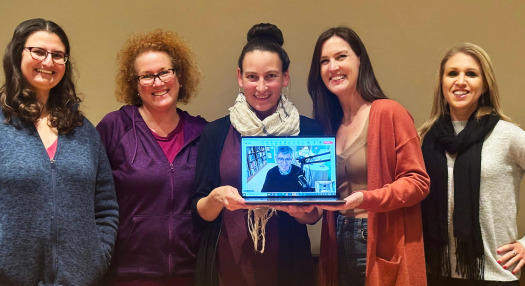
This year, SANDSWA’s May book club selection was Air-Borne: The Hidden History of the Life We Breathe, the latest volume by science writer and journalist Carl Zimmer. Our meeting, which took place at an unassuming Starbucks in East County, was extraordinary with Zimmer joining us on Zoom for a conversation.
Zimmer’s new book is a masterfully researched history of the troubled field of aerobiology. From miasma to Moderna, much of aerobiology’s scientific focus was on providing rigorous evidence for airborne transmission of diseases in plants, animals, or humans.
Zimmer’s storytelling conveyed both the history and controversy plaguing the scientific community’s understanding of airborne pathogen transmission. Following aerobiology from theory to practice, Zimmer expertly brings historical figures to life. Several chapters discuss the work and lives of power couple William Wells and his wife Mildred Weeks Wells, as they conducted early experiments on the airborne transmission of pathogens and how to prevent it, particularly in schools and hospitals. As with many of aerobiology’s pioneers, their theories were hotly contended but borne out with more experiments, forming a foundation on which today’s understanding of airborne transmission of infection is built.
Our discussion with Zimmer was wide-ranging, exploring pivotal moments in the calamitous history of aerobiology, SARS-CoV-2 lab leak theories, the plausibility of the shocker ending to The Last of Us(!), the book’s deeply researched biographies, and the future of storytelling.
Airborne Transmission & Lessons from the Pandemic
Several chapters are devoted to urgent questions from the COVID-19 pandemic. In the early days, much attention was focused on the viral mode of transmission, since different public health measures would be required depending on how the virus spread. Now an incredibly bright light is shining on the origins of SARS-CoV-2 with incendiary and unsubstantiated language from both the United States and China.
“When people talk about a lab leak theory, there are lots of different scenarios that people throw around that all supposedly fit under this rubric of lab leak theory. And that makes it a problem because you need to lay out a plausible hypothesis and test it,” Zimmer said.
As early as December 2019, the book details indirect evidence that a coronavirus jumped from a bat into an unknown animal in the wildlife trade, which was then sold in Wuhan. But the origins of the pandemic remains a topic of controversy. Recently in the New York Times, Zimmer writes about a new study comparing the genomes of bat coronaviruses, traveling hundreds of miles further than the animals can fly from their natural point of origin, through the wildlife trade. But the smoking gun is still elusive, an intermediate form of SARS-CoV-2 detected in a wild mammal that would make a definitive case for natural spillover, as they did with palm civets for SARS-CoV in 2003.
Zimmer commented that public health agencies and infectious disease experts are still synthesizing much of what was learned about COVID-19 and airborne transmission from the past five years, generating complex physical models of indoor spaces to minimize the risk people face in future pandemics. That work rests on models developed by aerobiologist William Wells and colleagues.
The Need for Meaningful Policy on Air Quality
It is inspiring to imagine a world where automated microbial collection and surveillance of the air helps us navigate the transient, life-filled biome we breathe daily. We could understand entirely new interactions between clouds, microbes, and precipitation, or measure the impacts of particulate matter from frequent wildfires and extreme weather events on the aerobiome. But what would really move the needle for Zimmer is decidedly more down-to-earth.
“What would really matter is having air standards like we do for water and food, mandated decades ago. As I write in the book, by the late 1800s, the germ theory of disease led to the recognition that contaminated water or food can kill, and there are ways to prevent that from happening. And those are not optional. So when is that going to happen for air? It hasn’t happened yet, but some states and other countries are making encouraging steps in the right direction.”
Dystopian Drama
Near the end of the book, Zimmer presents a discussion of fungal infections and spores. Last month, the TV series The Last of Us ended on an alarming note, and we couldn’t help but ask Zimmer about the scientific plausibility of that plot twist. While Zimmer is a fan of the story, a species-jumping infection scenario like Cordyceps doesn’t keep him up at night, but other fungal threats might. Writing about Valley Fever, caused bya soil fungus that travels through the air to infect susceptible people, Zimmer points out that climate change may expand the range of fungal spores, pushing infections further into unprepared communities.
The Future of Storytelling
The book begins and ends with the story of the Skagit Valley Chorale, a crucial early case study of how airborne transmission for SARS-CoV-2 was established. Zimmer recalled that “it was a very human story, a group of people who thought they were doing what they should be doing, suddenly dealing with this very traumatic event. I introduced myself and explained what I had in mind, and they asked me some questions and then talked among themselves. They decided they were okay with it, and then they were very transparent and forthcoming.”
We also asked Carl to peer into the future of storytelling in the digital age. Researching aerobiology’s past involved sifting through boxes of letters and personal accounts related to William Wells and Mildred Weeks Wells. It was through these papers that Zimmer could reconstruct the story of their work to prove that tuberculosis and measles could be transmitted through the air by evaporated respiratory droplets. How will we do that in the future when the internet is obviously not a faithful archive, and personal correspondence is encrypted, or disappears by design?
“I do wonder about what historians are going to do in 50 years. It was challenging for me working on this book because to track how public health agencies dealt with airborne disease through the pandemic, you really need to look at how those webpages were modified over time.”
He added: “Government records, studies and websites are disappearing, and there’s a huge effort to try to save this data for the future. It’s going to be tough. One of the reasons is that I think we kind of sleepwalked into the digital age thinking everything’s going to be online forever so we won’t have to worry about archiving. I think we have to worry more.”
Final Thoughts
When reading Air-Borne, it was clear to me just how new today’s knowledge and the tools we use for discovery and communication are (think genomics, the internet) and even with these tools, how little we still understand about the microbial world. Zimmer’s history of aerobiology is revealed as a cautionary tale of human ambition and the drive for legacy, and how when new evidence comes to light, scientists should always be ready to reevaluate what we think we know.
Air-borne: The Hidden History of the Life We Breathe by Carl Zimmer is available now: https://bookshop.org/p/books/air-borne-the-hidden-history-of-the-life-we-breathe-carl-zimmer/21681495?ean=9780593473597&next=t
Contributed by Amy Cullinan, Ph.D.
 SANDSWA